

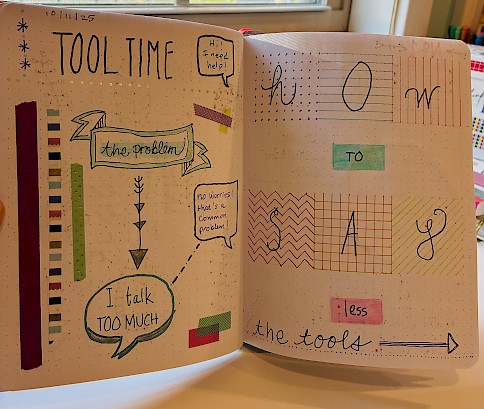
Do you ever just need to stop talking? Do you need to stop words from coming out of your mouth when you are standing right in front of a person you love who is behaving in ways that are making you angry/sad/frustrated/anxious/all of the above?
I find myself in this situation daily, mostly with my teenage son because (a) he is a teenager and (b) there are some other challenges going on with him. I want to say ALL THE THINGS, because I have the answers. The facts. The better way.
To be clear, I have already said all the things, and do you know much actual difference unleashing my firehose of information and disapproval has made? Very little, to him. But for me, it’s caused even more anger, sadness, frustration, and anxiety.
Saying too much makes my life worse, and doesn’t actually help the situation.
It’s taken me two years to realize this.
And yet, just yesterday I couldn’t stop talking. The night before had been bad, and that morning, I said all the things, all over again, culminating with, “And if you’re doing this shit next year when you’re 18, you won’t be welcome to live here anymore!” (It always culminates with me saying that.)
Sigh.
So yes, I struggle with the not-talking.
Luckily, there are some terrific tools to help people like me shut the hell up.
The tools come from recovery spaces, like 12-step and Smart Recovery. In the “friends and family” versions of these groups, the tools aren’t for the person with the problem. They’re for you.
Because, my friend, you also have a problem. A control problem. I can see it a mile away, because I have the deluxe model.
(FYI, You don’t need to have someone you love using substances or engaging in unhealthy behaviors to use these tools. The people who have developed these recovery tools are low-key geniuses in their understandings of human motivation, far beyond what we think of as “addiction.”)
5 Stop-Talking Tools: A Visual
A few months ago, I decided to start gathering the five best tools I’d been hearing about in meetings and on podcasts, and really reflect on them.
What are they?
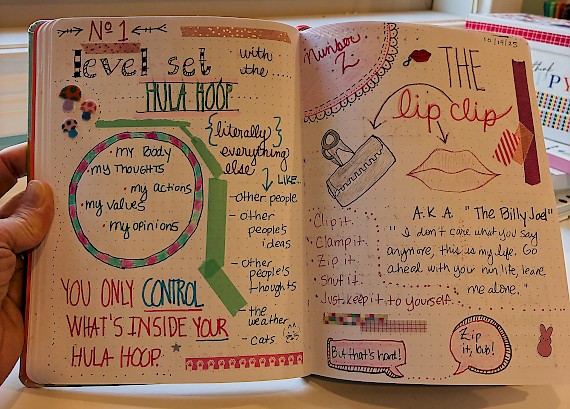
#1: The Hula Hoop
#2: The Lip Clip
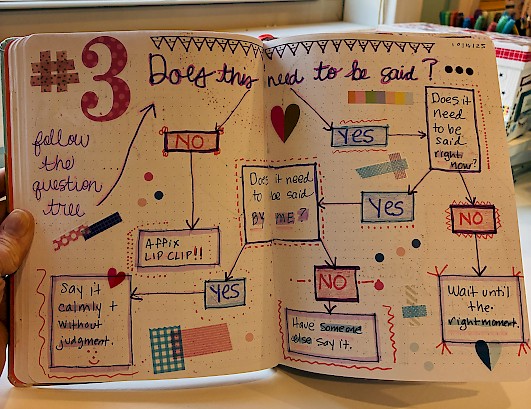
#3: Does This Need to be Said?
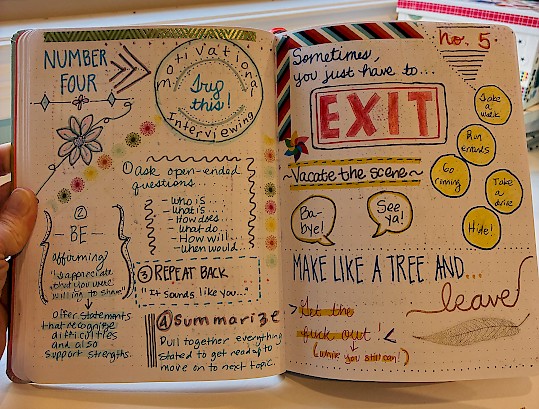
#4: Motivational Interviewing
#5: Leave the Scene
What the hell am I talking about? It’s far easier to show you the spreads I created in my dot journal to illustrate them.
Here’s how these tools might play out
Your loved one says, I’m going to [insert terrible idea]. You consider if it’s in your hula hoop. If it’s someone else’s actions, it’s not in your hula hoop.
So, you clip your lips shut.
But don’t they need me to tell them it’s a bad idea?
Nope.
Unless they have been marooned for several years on an island or have never had a conversation with you, they already know it.
Or, let’s say your loved one has just done something colossally stupid/dangerous/frustrating as hell, and some consequence has arisen because of it—a natural consequence which you allowed to happen. (Good job! That’s hard!)
But now, you are dying to say, “Do you know how stupid it was to [insert stupid thing]? Did you know I was up all night worrying? How are you even going to graduate high school? You’re not living here forever, I’ll tell you that! The next time, I will let the police just take you.”
Does this NEED to be said? The answer to that question any time you’re feeling reactive is almost always, “no.”
However, at some point, you—or someone else who is better able to stay calm—may be able to strategically circle back to the event.
And that circling-back point is where you might use motivational interviewing, which is essentially asking open-ended questions and really listening. You can learn a lot when you don’t rush to answer the questions for someone else.
But my favorite tool, and the one I am currently the best at, is GETTING THE HELL OUT OF DODGE. I struggle to put on my lip clip, to keep sight of what’s truly in my hula hoop, and to just fucking stay calm.
So, as long as it’s safe to do so, I leave.
Lately, I’ve been going to French Park here in Cincinnati. It’s about three miles from my house. It’s got a great vibe. I walk along the creek, which has a way of (at least temporarily) absorbing my stress and worry.
Each time, when I’ve come back home, the storm has passed, and I’ve avoided another circuitous, pointless conversation.
The next newsletter I do, I’m going to talk about something happy, like my favorite reads of the year. But this is where I’m living right now. Trying trying trying to practice these tools. Because it is a practice. And while I’m bad at not-talking, I’m pretty good at practicing.